
Innergize
How we turned a technically complex product into something a first-time user could understand and use easily
Stress is India's most common health problem and one of its least addressed. People know they need to do something about it. They're just not sure what works.
Innergize was built to answer that. It's a wearable device that sits behind the ear and uses Neuro-Acoustic Vagal Modulation, a clinical technology to trigger the body's natural relaxation response. Ten minutes. No medication. No side effects. Backed by 10,000+ user sessions and pre-clinical results showing a 36% drop in stress levels. What they needed, a few weeks before their Shark Tank India Season 4 appearance, was a website and an app that could explain all of this to someone who'd never heard of vagus nerve stimulation — and make them want to try it.

Innergize had two distinct digital problems, and both needed solving before millions of viewers opened their phones. The website existed. It did not convince. A product this science-heavy needs more than information — it needs a story. Viewers discovering Innergize through Shark Tank would land on the site with one question: does this actually fit into my life? The old site couldn't answer that. The app problem was different, and harder. Innergize's physical device can't function without the app — users initiate every session through it, track their insights, build their routine. But the v1 app was functional without being felt. It enabled the device. It didn't talk back. There was no warmth, no explanation of why a feature existed, no sense that the app understood the person using it. Users could complete a session and still leave wondering: is that it? Is that all I can do? For a product whose entire promise is that it fits into your life, an app that felt like a dead end was a serious problem.
We approached both the website and the app with the same principle: the technology is impressive, but the technology isn't the point. The point is what changes for the person using it. Every decision — structural, visual, verbal — was made to help someone move from I don't quite understand this to I can see this working for me.
Innergize's value proposition is calm. The website needed to feel it before explaining it.
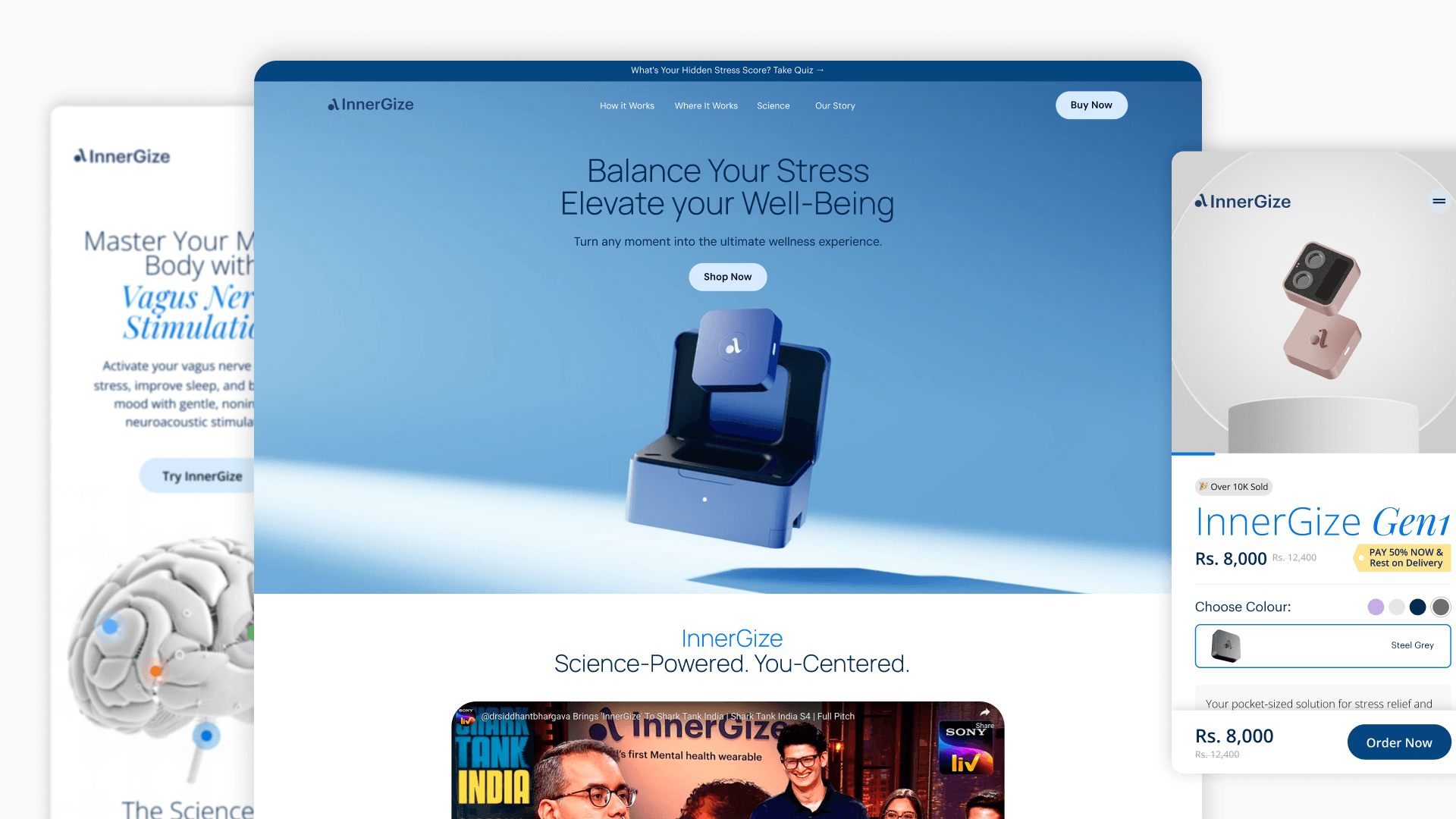
We reworked the information architecture so the site led with the user's day: waking up, working, unwinding, sleeping, and showed how Innergize slots into each moment. Rather than opening with clinical language, we opened with recognition. The science is there, but it arrives after the person has already seen themselves in the product.
The visual language followed the same logic. Modern, minimal, unhurried. Soft enough to signal relaxation without losing the credibility the product had earned. A wellness brand that felt anxious would be its own contradiction.
The result was a site ready to receive a national audience, one that could communicate what the product did, why it worked, and what a day with Innergize actually looked like.
We started with an audit. What we found was a navigation structure that restricted exploration, an onboarding that collected nothing meaningful, and a home screen that never changed. The app felt like it was waiting for the user to figure it out themselves.
We redesigned it around a different premise: don't fit yourself into the app, let the app fit into your life.
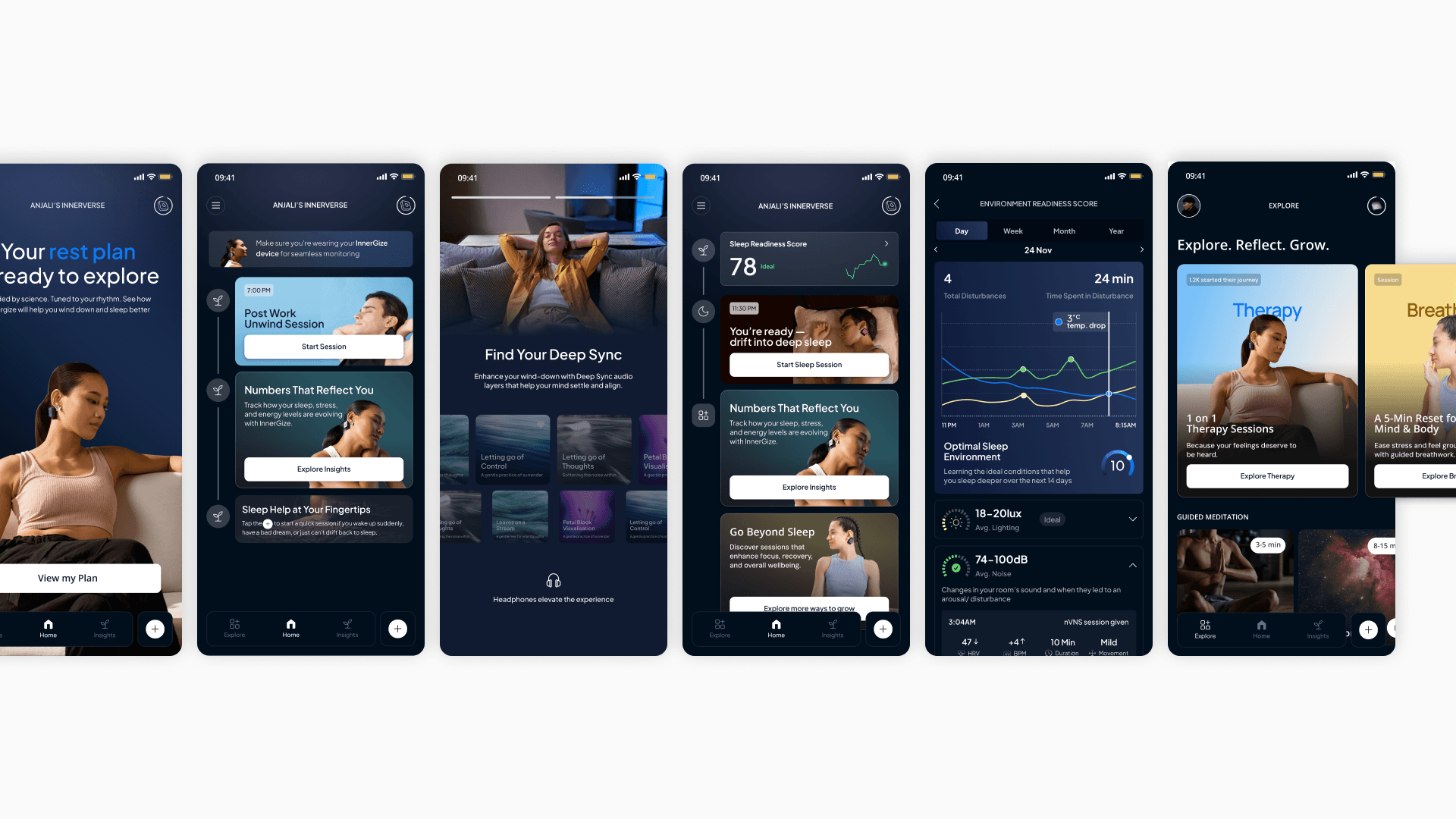
Onboarding became the first place that principle showed up. We asked users about their sleep and wake cycles, and we told them exactly why: so Innergize could build a session schedule around their actual day, not a generic template. That one change shifted the entire tone. The app stopped feeling like a device controller and started feeling like something that knew you.
The home screen became genuinely dynamic by surfacing sessions relevant to the time of day, adapting to what the user had told us in setup. Morning energy. Midday reset. Wind-down before sleep. The right session, offered at the right moment.
We introduced feature intro screens throughout. Short, plain-language explanations of the science behind each session. Not because users needed a lecture, but because understanding why you're doing something makes you more likely to do it again. Users who know that a 10-minute pre-sleep session activates the parasympathetic nervous system use it differently than users who just press play.
Finally, we built an Explore page, a home for the supporting features that weren't primary but were genuinely useful: breathwork tools, posture guidance, journaling, coach connections. Before, these were either buried or absent. Now they had a place, and users had a reason to go looking.
Innergize aired on Shark Tank India Season 4 and secured ₹1 crore in investment. Within 10 days of the episode airing, the team received over 1,200 orders, generating more than ₹60 lakh in sales. They went into the broadcast with 1,300 pre-orders already on the books. Total pre-seed funding reached ₹6.5 crore.
The website held up under the traffic. The app gave new users something to come back to.
Innergize didn't just need a digital presence for Shark Tank. They needed one that could convert the curiosity of a national audience into customers who understood the product well enough to trust it. That's what we built.