


Quick summary
- Pick a lane. Choose no-code for the fastest, lowest-cost launches, freelancers or small agencies to balance cost and delivery, or an in-house team for long-term control at higher fixed cost. Match the model to your timeline, cash runway, and tolerance for technical lock-in.
- Cost drivers. Hourly rates, UX polish, integrations, security, and project management move estimates dramatically. Multiply a base estimate by about 1.5 for polish, by 2 for integrations and auth, and by 3 for high-security work.
- Phase-based estimating helps avoid surprises. Break work into discovery, design, development, QA, and launch, estimate hours per role, and convert those hours into a blended project rate for a reliable quote.
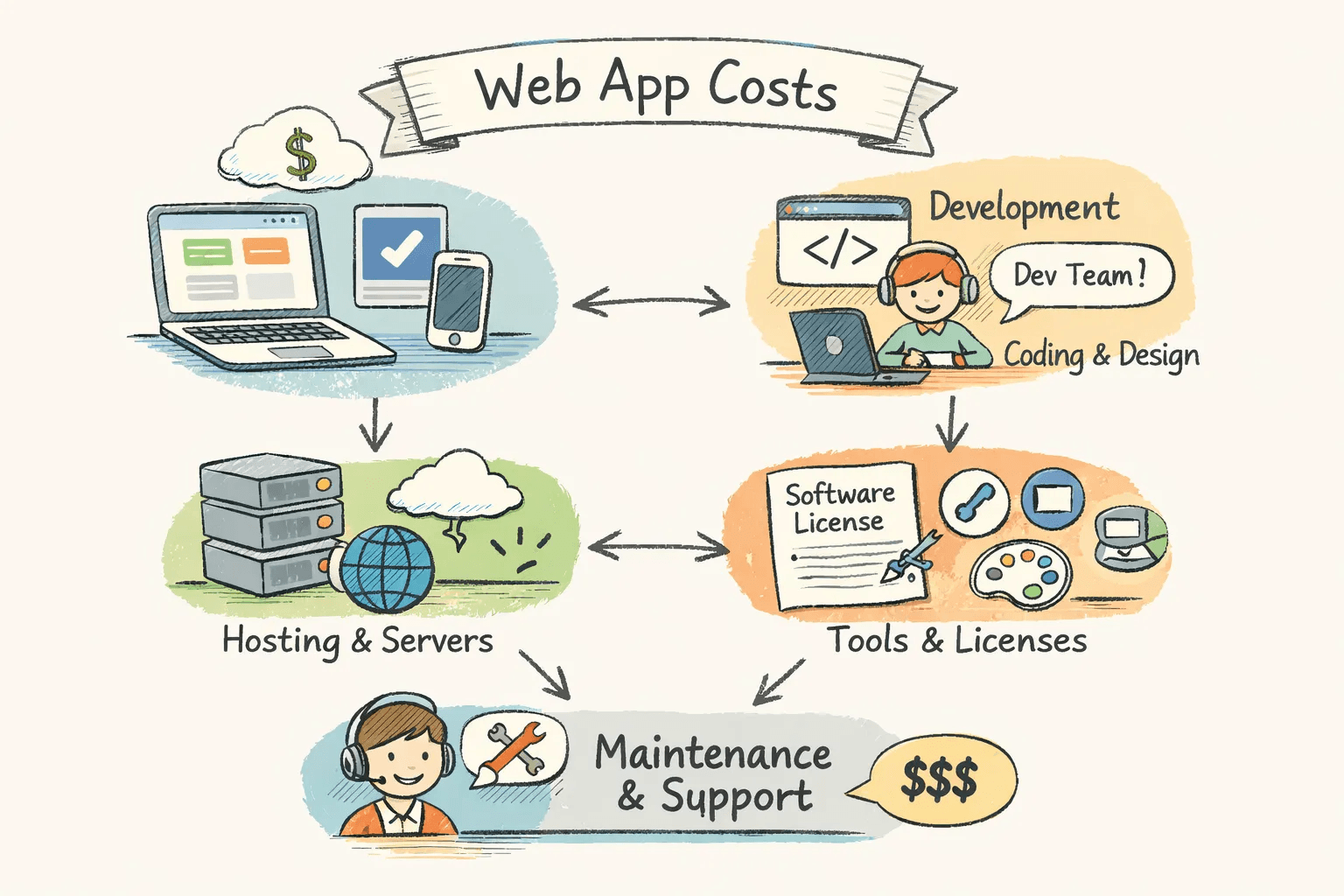
- Budget recurring costs. List hosting, third-party services, and maintenance as separate line items so ongoing spend is visible. Leaving them out often turns a low initial MVP cost into a much larger ongoing expense.
- Contingency and tradeoffs. Add a 10 to 25 percent contingency and use a simple decision matrix to balance speed, cost, and flexibility. A pricing calculator or scope audit moves you from ranges to a firm quote.
At-a-glance budgets by approach (120–160 words)
If you need a quick reference, here are typical ranges for a simple web application. No-code platforms: $1,000 to $15,000 and launch in weeks; freelancers: $10,000 to $30,000 over 6 to 12 weeks; small agencies: $15,000 to $40,000 with an 8 to 12 week delivery; in-house builds: $20,000 to $50,000 or more once hiring overhead and tooling are included.
The same feature set lands in different bands because developer rates, UI polish, integrations, security requirements, and project management vary. Use multipliers to adjust a base scope — roughly 1.5 for polished UI, 1.5 to 2 for integrations and auth, and add 15 to 25 percent for PM and coordination — then add 10 to 25 percent contingency and monthly maintenance to get a realistic budget.
Phase-by-phase line items and hours
Start with discovery to produce a scope document, prioritized user stories, low-fidelity wireframes, and a tech-stack decision. Lean or no-code discovery typically takes 20 to 80 hours; at $50 per hour that is about $1,000 to $4,000, at $100 per hour $2,000 to $8,000, and at $150 per hour $3,000 to $12,000. Full custom discovery commonly ranges from 80 to 200 hours, costing roughly $4,000 to $30,000 depending on rates and depth. (For related thinking on lean approaches see lean startup development.)
Design covers low-fidelity wireframes, hi-fidelity screens, responsive variants, and a basic design system. Lean design usually runs 20 to 120 hours while custom design often sits at 120 to 400 hours. Expect roughly 4 to 10 hours per screen for lean work and about 10 to 30 hours per custom screen, with totals scaling by number of screens and responsive states.
Development splits into frontend, backend, and integrations, and you should estimate frontend and backend separately. Typical bands: frontend 80 to 300 hours, backend 80 to 300 hours, and integrations such as auth, file storage, payments, email, and analytics 20 to 120 hours. Common time sinks include authentication (20 to 80 hours), payments (30 to 80 hours), and complex API work, with total development often between 180 and 720 hours. For industry references on typical timelines, see typical web development timelines.
At $50, $100, and $150 hourly rates, that development band converts roughly to $9,000 to $108,000. Map your scope to these ranges to find the biggest levers for trimming time or moving work to a lower-cost lane.
QA, deployment, and launch wrap the project with functional tests, cross-browser checks, basic security reviews, CI/CD, and hosting setup. QA is usually 80 to 200 hours for a full custom build and 20 to 80 hours for template or no-code builds, and plan one-off deployment and cutover support at roughly $500 to $3,000 plus 10 to 40 support hours. With these phase hours in hand, you can map them into example project budgets by approach to pick the right path for your product.
Role rates and building a blended project rate
Use current market rates when estimating work: frontend about $55 to $65 per hour, backend $55 to $65, full-stack $50 to $70, UI/UX $50 to $70, QA $45 to $65, and PM $65 to $90. To adjust for region apply multipliers: EU roughly 1.05 to 1.15, Eastern Europe 0.60 to 0.80, and Asia 0.45 to 0.65. Convert a US baseline into local rates so your budget matches the market you hire from (see the technology salary guide).
Compute a blended rate to turn role-level estimates into one easy number. Use the formula: blended rate = sum(role_hours × role_rate) ÷ total_hours. A single blended rate simplifies proposals, makes vendor comparisons fair, and helps forecast overall cost without juggling every line item.
Example for a 400-hour simple app: allocate frontend 160 hours at $60, backend 120 hours at $60, UI/UX 40 hours at $60, QA 40 hours at $55, and PM 40 hours at $77.50. The total cost is $24,500 and the blended rate is $24,500 ÷ 400 = $61.25 per hour. Applying an Eastern Europe multiplier of 0.70 yields a blended rate near $42.88 per hour and a project total close to $17,150.
With a blended rate in hand, set fixed-price milestones for well-scoped deliverables like UI delivery or an API integration, and use hourly for discovery or open scope. Vendors often bake risk into hourly bids, so define acceptance criteria and handoff signals in milestones to transfer delivery risk back to the vendor.
Four copyable sample itemized budgets (120–180 words)
Below are four copyable baseline budgets for a basic web app. Each example assumes basic features, one revision round, and a short launch timeline; adapt the line items to your specific scope and platform.
DIY / no-code (≈ $750)
This option uses a hosted no-code platform, a template, and light integrations for the fastest pilot. It requires minimal developer time but limits custom UX and future extensibility.
- Platform subscription: $250. Covers the hosted app plan and any built-in automation or plugin fees needed for a pilot.
- Template/component: $150. A prebuilt UI reduces design time and speeds launch.
- Integrations: $100. Basic payment, email, or webhook setup on starter tiers.
- Domain and hosting: $100. Domain registration plus platform hosting or a small VPS.
- Misc tools: $150. Analytics, form builders, and small add-ons.
- Total ≈ $750. This sum covers an MVP launched on a hosted no-code platform.
Freelancer (example $8,500)
A single senior generalist handles most roles over 4 to 6 weeks with one revision round. This model keeps coordination simple but concentrates delivery risk on one person.
- Discovery: $1,000. Scope, wireframes, and feature prioritization to lock the MVP.
- UI/UX: $1,500. Senior design work with one round of revisions.
- Frontend and backend: $4,500. Core development for client and server features.
- QA: $800. Functional testing and basic cross-browser checks.
- Deployment: $400. One-time deployment and launch support.
- PM: $300. Light coordination and status tracking.
- Total ≈ $8,500. Suited to founders who want a low-touch vendor with one point of contact.
Small agency (example $22,000)
An agency model adds project management, warranty, and tested delivery processes for higher reliability. Expect clearer handoffs and more formal QA, at a higher price.
- PM and discovery: $3,000. Structured kickoff, scope, and planning with a dedicated PM.
- Custom UX: $4,000. Polished design and interaction patterns.
- Frontend: $6,000. Responsive UI implementation and accessibility basics.
- Backend: $5,000. Data model, APIs, and integrations.
- Testing and security audit: $2,000. Functional, regression, and basic security checks.
- Hosting setup and warranty: $2,000. Production readiness and short-term support.
- Total ≈ $22,000. Best for founders who value reliability and a managed delivery process.
Offshore team (example $7,200)
Lower hourly rates with higher coordination overhead and time zone trade-offs. This path reduces cost but requires stronger product ownership from the founder.
- Discovery: $800. Basic scope and technical decisions with remote coordination.
- Design: $1,200. UI work adapted for development handoff.
- Development: $3,500. Core frontend and backend build at lower rates.
- QA: $1,000. Testing and issue triage, often requiring extra communication cycles.
- Deployment: $500. Production cutover and handoff support.
- Tools: $200. Collaboration and CI tooling subscriptions.
- Total ≈ $7,200. Works when budget constraints outweigh coordination costs.
Use these examples to define decision criteria around timeline, risk tolerance, and long-term maintenance obligations. Adapt line items and hours to your product to move from a baseline to a firm quote. For an additional industry reference on cost ranges, see this detailed web app cost breakdown.
Hosting, third-party fees, and maintenance you must budget for
Recurring infrastructure and service fees are small individually but add up as you scale, so map monthly and annual hosting line items up front. Know the load thresholds where plans change: modest static traffic fits starter tiers, while concurrent users or heavy API use push you into higher-priced plans. Forecast these thresholds so you can anticipate step increases in cost as user volume grows.
- Hosting: $2 to $50 per month for small apps on shared or entry VPS plans. Costs increase significantly when you move to dedicated instances or autoscaling cloud services. (See a roundup ofhosting providers with monthly plans.)
- Managed database: free to $20 per month for tiny tiers; production databases cost more once you need high availability or larger storage. Plan for backups and failover as you move to production.
- CDN: free to $10 per month for small sites, with bandwidth-based pricing rising at scale. Heavy media or international traffic can push CDN costs up quickly.
- Backups and SSL: often free in starter tiers, but paid backups for retention add extra. Certificate renewals and retention policies should be part of the plan.
- Domain: $10 to $20 per year. Expect renewal and optional privacy fees on top.
Third-party APIs and transactional services like Stripe, SendGrid, maps, and analytics commonly offer free tiers that cover pilots, but costs rise with volume and added features. Use a working rule of thumb of $0 to $100 per month for light usage and expect step increases as users and integrations scale. Budget maintenance, security, and unexpected fixes with a dedicated line item: around 10 to 30 percent of the initial build cost per year or a monthly retainer of $500 to $3,000 depending on complexity.
Choose the fastest path and cut costs without sacrificing outcomes
Seven pragmatic tactics preserve quality while trimming spend:
- Prioritize one user journey. Focusing on a single path typically cuts scope 20 to 40 percent and reduces launch complexity.
- Reuse open-source templates. Starting from a proven UI can shave 15 to 30 percent off design time while keeping consistency.
- Adopt backend-as-a-service. BaaS removes significant backend build time and can save roughly 25 percent on development for common features.
- Automate basic tests. Simple automated tests reduce future bug costs and maintenance overhead by 10 to 20 percent.
- Batch related tasks with the same developer. Keeping related work with one person cuts coordination overhead about 10 to 25 percent.
- Negotiate fixed milestones. Fixed-price milestones limit scope creep and protect the budget by making acceptance criteria explicit.
- Freeze scope after launch. Locking scope for the critical early phase avoids large add-on costs while you validate product-market fit.
How The MVP Studio scopes projects: we offer a fixed-scope 100-day package or phased scoped quotes with transparent line items and role-level rates. Our estimator converts chosen hours and rates into a vendor-ready web application pricing breakdown so founders see how money maps to deliverables and timing. That approach supports founders who need credible branding and polished design before market entry while maintaining delivery certainty.
Final thoughts on cost breakdown for building a simple web application
This cost breakdown gives a practical way to choose a budget path and move quickly from ranges to a firm quote. Use the at-a-glance budgets to pick a lane, map scope to phase hours, apply role rates to get a blended project rate, and add contingency and maintenance before committing to scope. For ongoing reads and tactical breakdowns, visit our Insights.